
Student Agency: Level Up!
- EmpoweredJCPS

- Oct 30, 2019
- 2 min read
Teacher: Michael Butler
School: Clayton Middle
Focus Area: Student Agency/Learning Paths
Grade/Subject: 7th Grade Science
While we were visiting to see the learning in action, we saw some amazing things. Students were actively engaged, collaborating, and there was a definite sense of community in the classroom.

Today's post spotlights the innovative work that Michael Butler at Clayton Middle School is doing with his 7th grade science students. Mr. Butler is developing systems and learning activities to promote student agency and learning pathways. He has adapted a system he learned from a colleague in which Level Up cards are used to define not only learning targets, but how proof of learning will be demonstrated as well.
The Level Up cards provide several important facets to the structure of the class. First, they let students know specific learning targets that need to be achieved in order to level up toward proficiency or beyond. Second, they tell students how they will be able to show proficiency. Something to note about this is the fact that it is not always necessary to take a quiz or test in order to move to the next level. Many different methods, such as video, graphic organizers, and verbal answers, are used as formative assessments as students progress towards proficiency. Finally, the system lets both the teacher and the student know how learning is progressing.

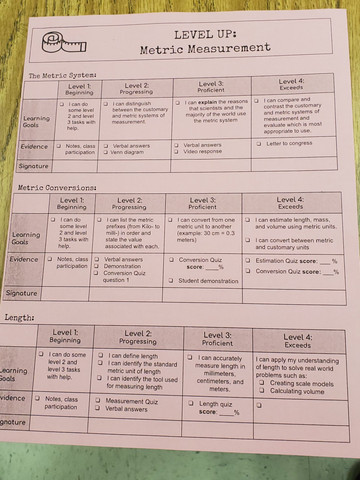


While the Level Up cards provide detailed learning targets and information on how to demonstrate learning, one of the challenges Mr. Butler wanted to overcome was how to effectively communicate options for learning to students. He knew from past experience that providing students with large blocks of text was not as effective as he would like.

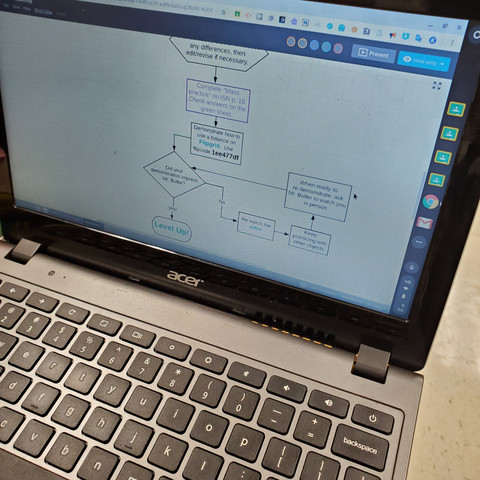


The solution to this was to make the learning options visible using a digital tool called Lucid Chart. Lucid Chart allows you to make flowcharts with text and links to other documents. Using this digital tool, Mr. Butler made a flowchart for each Level Up card and level with links to learning resources and options.
These flowcharts are hosted in Google Classroom, allowing easy access for students. During the learning time, students have the choice as to what order that they work on the various concepts of the unit. They sit at tables with others who are working on the same thing, allowing them to assist each other and access resources as needed. Throughout the class period, Mr. Butler holds seminars on topics and students can come to the area where he is providing direct instruction.


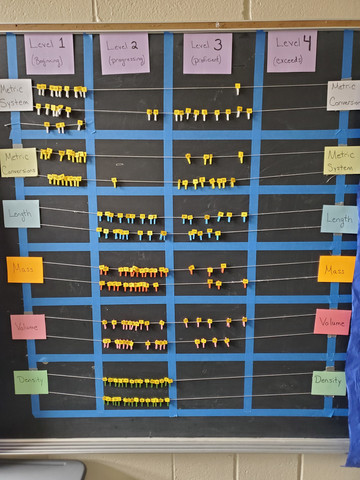
As students progress through the learning, they move their clips to note where they currently have achieved and what they need to focus on. This visual also allows the teacher to quickly and easily find students who might be falling behind or target areas that students are avoiding.
While we were visiting to see the learning in action, we saw some amazing things. Students were actively engaged, collaborating, and there was a definite sense of community in the classroom. Mr. Butler did want it noted that the upfront work is substantial. The payoff is great, but it is definitely a different way of approaching planning in which most of the work is done upfront, allowing you to spend more time with students during the learning.
Comments